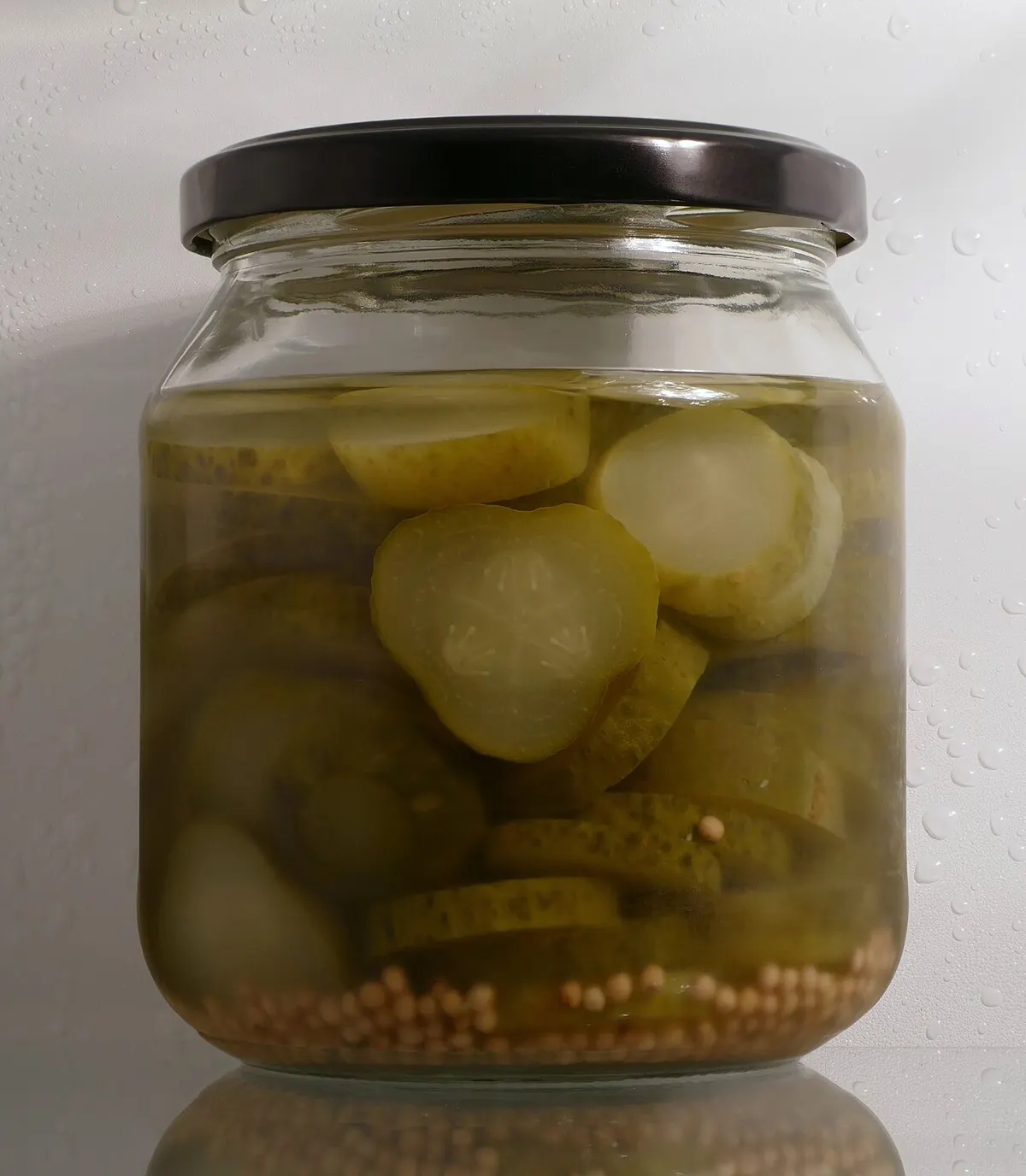
The best fermentation weights do one dull, important job: they hold vegetables under the brine so the parts above the surface do not grow mold. That is the whole pitch. A weight is a disc of glass, ceramic, or stone, or a stainless coil that pushes down instead, and the difference between the good ones and the bad ones comes down to diameter, heft, and whether you can get the thing back out of the jar.
How we built this guide: we have not bench-tested these weights. The picks are based on manufacturer specifications, listed dimensions and masses, extension fermentation guidance, and patterns in owner reviews. Prices come from a live product feed and carry a date.
Do you actually need a fermentation weight?
Not a purchased one. The National Center for Home Food Preservation’s sauerkraut method says to “add plate and weights” and then cover the container with a clean towel, and it offers two free alternatives: a brine-filled food-grade bag, or jars of water sitting on a plate. University of Minnesota Extension puts it plainly too: weigh the produce down if needed, and keep 1 to 2 inches of brine above it.
What you cannot skip is the submersion. Everything above the brine line is exposed to air, and air is where Kahm yeast and mold set up. A weight is just the most convenient way to win that argument for 3 or 4 weeks straight.
There is a real tradeoff in the free options. NCHFP notes that if you use jars of water as the weight, you have to check the kraut 2 or 3 times a week and skim off any scum that forms. With a brine-filled bag, you leave the container alone until bubbling stops. A purchased weight behaves more like the bag: set it and leave it.
What makes a good fermentation weight?
Four things, in order of how often they cause problems.
Diameter. A weight that is too small lets cabbage squeeze up past the edge. The glass weights sold for wide mouth mason jars run about 2.6 to 2.8 inches across, which fills most of the opening and leaves just enough gap to get a finger in. Wide mouth jar lids are 86 mm across, so nearly every weight on the market is built for that size.
Mass. Shredded cabbage pushes back harder than people expect in the first week, when carbon dioxide production peaks. Listed masses for 4-packs of glass weights run from about 15.5 ounces to 0.7 kg per set, which works out to roughly 4 to 6 ounces per weight. The heavier end holds better.
A handle. Older glass discs were flat, and the only way out of a full jar of brine was your fingers. Every pick below has a grip or a knob. This is the single biggest quality-of-life upgrade in the category.
Material. Glass is non-porous and easy to sanitize. Unglazed ceramic is heavy and traditional but porous, which makes it harder to clean once something grows on it. Stainless is inert in the right grade. Minnesota Extension’s warning about metal is specifically about containers, since metal reacts with the lactic acid the bacteria produce, but it is worth knowing before you improvise with a can or a steel bowl.
Glass vs ceramic vs stainless: which type should you buy?
| Glass disc | Ceramic crock weight | Stainless coil | Improvised | |
|---|---|---|---|---|
| Fits | Wide mouth jars | One matching crock | Any mason jar | Whatever it fits |
| Typical mass | 4 to 6 oz each | 4 lb and up | Spring tension, not mass | Varies |
| Porous | No | Yes, if unglazed | No | Varies |
| Displaces brine | Yes | Yes | Very little | Usually a lot |
| Cleaning | Dishwasher, easy | Hand wash, hard to sanitize | Dishwasher | Varies |
| Cost per unit | About $3.75 to $5.40 | About $29 | About $9.20 | Free |
| Main failure | Chips if dropped on glass | Grows film in the pores | Costs more upfront | Leaks, floats, or sticks |
For a mason jar, buy glass. For a crock, you want the heavy ceramic or glass disc sized to that crock. The stainless coil is the interesting outlier, and it is worth reading before you decide.
The best fermentation weights for mason jars
Best overall: Country Trading Co. glass weights, set of 4
These are the heavier glass discs in the mainstream price range. The listing gives 2.6 inches across and 0.7 kg for the set of four, which is about 6.2 ounces per weight, and the whole selling point in the maker’s own copy is that unlike lighter discs they are heavy enough to hold an active ferment down. Wide lifting handles, smooth glass, dishwasher safe.
Owner reviews run 4.6 out of 5 across roughly 1,160 ratings. The recurring praise is heft and the handle. The recurring complaint in this whole product category, not just this one, is chipping when a glass weight meets a glass jar rim at speed. Lower it, do not drop it.
Why it is our top pick: the most mass per weight of the mason jar glass options we looked at, at a price that is not silly.
Pantry pick: Country Trading Co. Glass Fermentation Weights, Set of 4

Four glass weights with lifting handles for wide mouth jars, listed at 2.6 inches across and 0.7 kg for the set. Based on manufacturer specs and owner review patterns. Tradeoff: glass chips if you drop it against a jar rim.
Best value: SOLIGT glass weights, set of 4
The most-bought weight in the category, with about 6,495 ratings at 4.6 out of 5 and a top-five ranking in Amazon’s brewing and fermentation equipment list. The listing gives 2.76 inches across and 0.98 inches thick, lead-free non-porous glass, dishwasher safe, with a bulge-style handle instead of a groove.
The listed mass for the set is 15.52 ounces, roughly 3.9 ounces per weight, so these are lighter than our top pick. For a pint or quart of kraut that is usually fine. For a packed half gallon in week one, the extra ounces matter.
Why it made the list: the widest owner track record in the category and the lowest price per weight of the glass picks.
Pantry pick: SOLIGT Fermentation Glass Weights, 4 Pack

Four lead-free glass weights for wide mouth jars, listed at 2.76 inches across and 0.98 inches thick, dishwasher safe. Based on manufacturer specs and owner review patterns. Tradeoff: lighter than the heavier discs, so a vigorous half gallon batch can still push up past them.
Best for a full shelf of jars: Masontops Pickle Pebble Infinity, 8 pack
Masontops makes the lids most jar fermenters already own, and the Pickle Pebble is the matching weight. The maker says they are the same food-safe soda lime glass as a mason jar, non-porous and crystal clear, with a patented finger grip for pulling them out. The wide mouth 8-pack is listed at 3.3 pounds, which is about 6.6 ounces per weight, the heaviest of our glass picks. It is also sold in a regular mouth version, which is rare.
The catch is price. At $42.99 for eight you are paying about $5.37 per weight, a dollar and a half more than the value pick. What you get is heft, a brand with 4,023 ratings at 4.7 out of 5, and enough weights to run eight jars at once without rotating them.
Why it made the list: the heaviest per weight, and one of very few lines that sells a regular mouth size at all.
Pantry pick: Masontops Pickle Pebble Glass Infinity Weights, Wide Mouth 8 Pack

Eight soda lime glass weights with a finger grip, listed at 3.3 pounds for the set, dishwasher top rack safe per the maker. Based on manufacturer specs and owner review patterns. Tradeoff: the highest price per weight here, and stock on the 8-pack runs thin.
The one that is not a weight at all: Trellis + Co. Pickle Helix
A stainless coil that compresses against the underside of the lid and pushes the ferment down with spring tension rather than mass. Trellis says the coils are 316 stainless, made in the USA, and self-adjust as the ferment settles, and that they do not displace brine the way a glass disc does. Three coils run $27.66, which is about $9.22 each, the priciest per unit here. Ratings are 4.8 out of 5, but on only 96 ratings, so the track record is thinner than the glass picks.
Two honest caveats. It needs a lid to push against, so it is not a drop-in replacement if you ferment under a cloth. And Minnesota Extension warns against metal containers because metal reacts with lactic acid; 316 is the grade the maker says commercial fermenting equipment uses, but that is the manufacturer’s claim about the alloy, not an extension endorsement of the product.
Why it made the list: it solves the one problem no glass disc solves, which is that a disc big enough to hold cabbage down also displaces a cup of brine.
Pantry pick: Trellis + Co. Stainless Steel Pickle Helix Coils, 3 Pack

Three 316 stainless coils that hold a ferment down by spring tension instead of mass, self-adjusting to any mason jar size per the maker. Based on manufacturer specs and owner review patterns. Tradeoff: highest cost per unit, and it needs a lid to press against.
What about weights for a crock?
Different problem entirely. A crock holds gallons, not quarts, and the weight is usually two half-moon pieces that drop in flat and cover almost the whole surface.
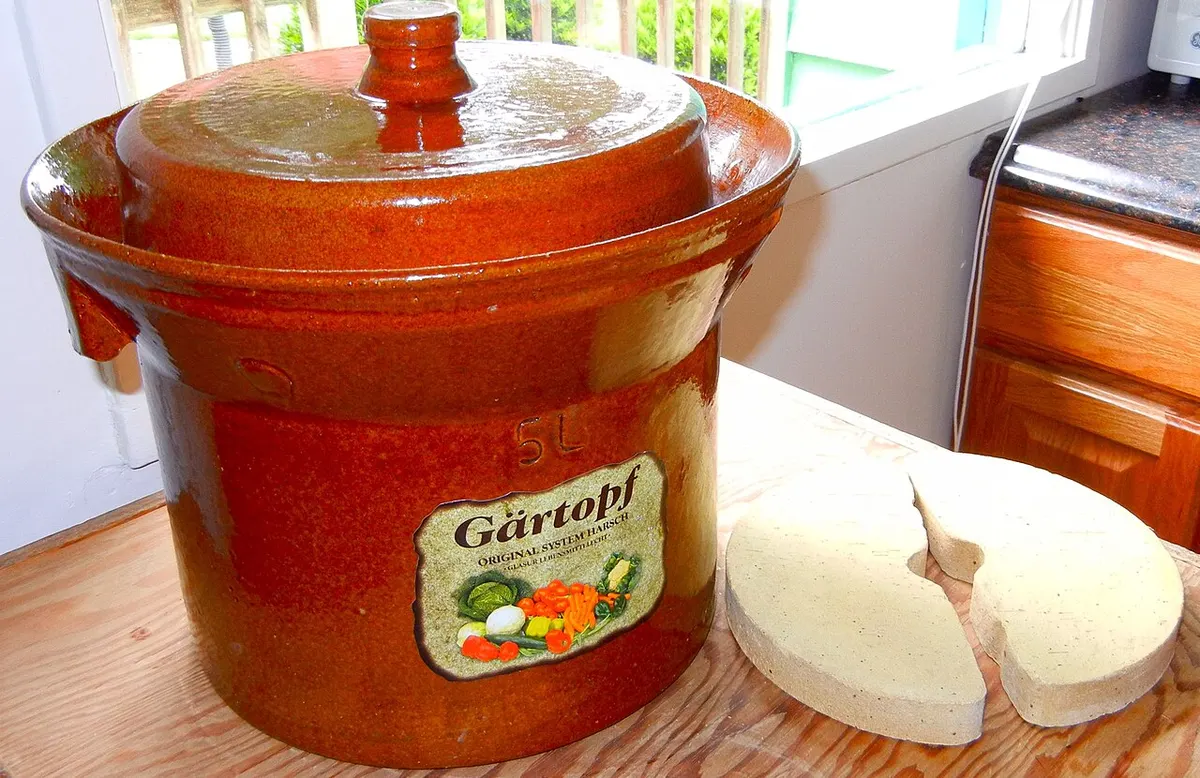 The classic arrangement: a water-seal crock and two half-moon weights that cover nearly the full surface. Photo: Bdubay, CC BY-SA 3.0, via Wikimedia Commons
Most crocks ship with weights, so check before buying. If yours came without them, or one cracked, replacements are sold by crock size. The Ohio Stoneware 2 gallon weight is listed at 7.63 inches across, 1 inch thick, and 4 pounds. That is ten times the mass of a jar weight, which is what a few pounds of cabbage requires.
The tradeoff with traditional crock weights is the one everyone skips past: unglazed stoneware is porous. It absorbs, and once something grows in the surface it is hard to sanitize. Keep it under brine, wash it promptly, and dry it fully.
Pantry pick: Ohio Stoneware 2 Gallon Preserving Crock Weight

A 4 pound stoneware weight listed at 7.63 inches across and 1 inch thick, sized for a 2 gallon crock, lead free and dishwasher safe per the maker. Based on manufacturer specs and owner review patterns. Tradeoff: unglazed stoneware is porous, so clean it promptly and store it dry.
If you do not own a crock yet and are reading this to size one, start with our fermentation crock guide instead, since most crocks include weights.
Fermentation weight comparison
| Weight | Material | Per pack | Listed size | Mass per weight | Price per weight (as of Oct 26, 2026) |
|---|---|---|---|---|---|
| Country Trading Co. | Glass | 4 | 2.6 in across | About 6.2 oz | $4.25 |
| SOLIGT | Glass | 4 | 2.76 in across, 0.98 in thick | About 3.9 oz | $3.75 |
| Masontops Pickle Pebble | Soda lime glass | 8 | Wide mouth | About 6.6 oz | $5.37 |
| Trellis + Co. Pickle Helix | 316 stainless | 3 | Self-adjusting | Spring tension | $9.22 |
| Ohio Stoneware crock weight | Stoneware | 1 | 7.63 in across, 1 in thick | 4 lb | $28.99 |
Mass figures are calculated from the listed pack weight divided by the piece count, so treat them as close rather than exact.
What can you use instead of a fermentation weight?
Plenty, and the tested sources say so themselves.
- A smaller jar. A 4 ounce jelly jar nests inside a wide mouth jar and works as a counterforce. It eats headspace, which is the catch.
- A water-filled jar on a plate. This is the NCHFP crock method. Remember the tradeoff: you then need to check the ferment 2 or 3 times a week and skim scum.
- A brine-filled bag. Also NCHFP. Fill a food-grade bag with brine, not plain water, so a leak does not dilute anything. The upside is that you can leave the container alone until bubbling stops.
- A clean stone. Boil it first. Skip limestone, which reacts with the acid.
- Pressing it down by hand. Free, and it works, but every time you open the jar you let fresh air in.
What not to improvise with: anything metal that is not a known food-grade stainless, anything painted or glazed with unknown glaze, and plastic that is not food-grade.
How to use a fermentation weight without problems
- Pack first, weigh second. Press the vegetables down until the brine rises above them, then set the weight on top.
- Leave the brine 1 to 2 inches above the vegetables, per Minnesota Extension, and leave room above that for bubbling.
- If the brine does not cover everything, add more. NCHFP’s top-up brine is 1-1/2 tablespoons of salt per quart of water, boiled and cooled.
- Hold 70 to 75°F. NCHFP says kraut is fully fermented in about 3 to 4 weeks at that range, 5 to 6 weeks at 60 to 65°F, may not ferment below 60°F, and can go soft above 75°F.
- Lower the weight, do not drop it. Glass against a glass rim is how weights chip.
- Wash and dry it fully between batches. Glass goes in the dishwasher. Unglazed ceramic does not get truly sanitized, so keep it clean from the start.
The short version
- The best fermentation weights for mason jars are glass discs about 2.6 to 2.8 inches across with a lifting handle, weighing roughly 4 to 6 ounces each.
- Wide mouth jars take 86 mm lids, and almost all weights are built for that size. Regular mouth weights exist but are uncommon.
- Crock weights are a different scale: the Ohio Stoneware 2 gallon weight is 7.63 inches across and 4 pounds.
- Weights are optional. NCHFP’s own sauerkraut method accepts a water-filled jar on a plate or a brine-filled bag, though the jar method means skimming scum 2 or 3 times a week.
- Keep 1 to 2 inches of brine above the vegetables, per University of Minnesota Extension.
- As of Oct 26, 2026, glass weights ran $3.75 to $5.37 each, the Pickle Helix coils $9.22 each, and the Ohio Stoneware crock weight $28.99.
Related guides
Put the weights to work with how to make sauerkraut in a mason jar, and get the salt right first with our fermentation salt ratio guide. Pair them with the right fermentation lid, and if you are new to all of this, start with the beginner’s roadmap. For the underlying methods, read the NCHFP sauerkraut instructions and University of Minnesota Extension on fermentation.